
The Challenges of Manual Payroll Processing
Imagine this scenario… It’s the end of the month, and your HR team is rushing to process salaries. Attendance sheets are collected from supervisors, leave records are checked manually, overtime hours are confirmed, late entries are verified, and employee changes are updated in spreadsheets. Meanwhile, the payroll team waits impatiently for final data so they can calculate salaries, taxes, deductions, allowances, reimbursements, and overtime.
Hours pass… Someone realizes a mistake in attendance. Another discovers that a new employee’s salary was not added. A resignation was missed. Overtime was calculated incorrectly. Leave encashment records don’t match. Suddenly:
✅ Salary calculations get delayed
✅ Employees start asking questions
✅ HR gets stressed
✅ Payroll accuracy becomes questionable
By the time everything is sorted, the team feels exhausted and frustrated and employees feel unhappy because payments were delayed or wrong. This situation is extremely common in organizations where HR, payroll, and attendance systems work separately. Manual data transfer and multiple records create confusion, errors, and unnecessary workload.
The Solution: Integrated Payroll Management
Now imagine a different scenario…The attendance system automatically records employee presence. Leave approvals update instantly. Overtime and shift details sync in real-time. Employee profiles update automatically. At the end of the month, payroll simply clicks one button—and all data flows in accurately.
No manual entry. No cross-checking. No salary disputes. No delays.
This is the power of integrating payroll systems with HR and attendance management.
What Does Payroll Integration Mean?

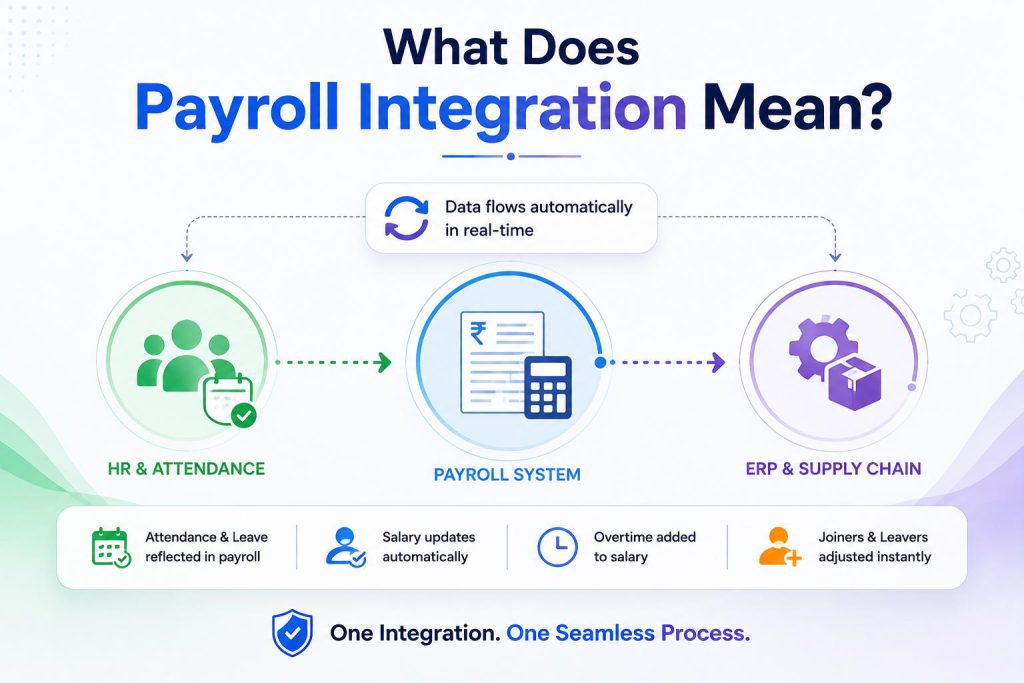
Payroll integration means connecting payroll software with HR and attendance systems so that employee information flows automatically between them. Instead of updating multiple systems manually, everything stays synchronized in real-time.
For example:
- When an employee takes leave → reflected in payroll
- When attendance is marked → salary updates automatically
- When overtime is approved → added to salary
- When an employee joins or leaves → payroll adjusts instantly
This integration creates a seamless process where HR, attendance, and payroll work together as one system.
Why Is Integration Important?
- Modern businesses deal with complex workforce structures, including multiple employee shifts, hybrid and remote work setups, contract workers, and full-time employees, making payroll processing more complicated than ever.
- Many organizations also manage overtime, variable pay components, incentives, and frequent employee changes, which require constant updates across HR, attendance, and payroll systems.
- Without integration, HR teams must manually collect and verify attendance, leave records, overtime details, and employee updates, making payroll processing extremely time-consuming and inefficient.
- Manual handling increases the chances of errors, such as incorrect salary calculations, missed overtime payments, wrong deductions, or outdated employee information, leading to payroll disputes and dissatisfaction.
- The entire process becomes stressful for HR and payroll teams, especially during month-end when they rush to compile information from multiple sources under tight deadlines.
- Manual systems also become expensive, as they require more manpower, longer processing hours, and may result in financial losses due to mistakes or compliance penalties.
- Integration ensures payroll data flows automatically from attendance and HR systems, making salary processing accurate, with correct calculations for attendance, leaves, and overtime.
- Payroll becomes faster, as the system already has all required information, allowing salaries to be processed in minutes instead of days.
- Integrated systems create an automated workflow, reducing manual intervention and eliminating repetitive data entry tasks.
- Payroll also becomes transparent, giving employees clear visibility of attendance, leaves, and salary components, building trust and reducing disagreements.
- Overall, integration reduces manual work, minimizes errors, improves communication between departments, and enhances overall operational efficiency.
Benefits of Integrating Payroll with HR and Attendance Management
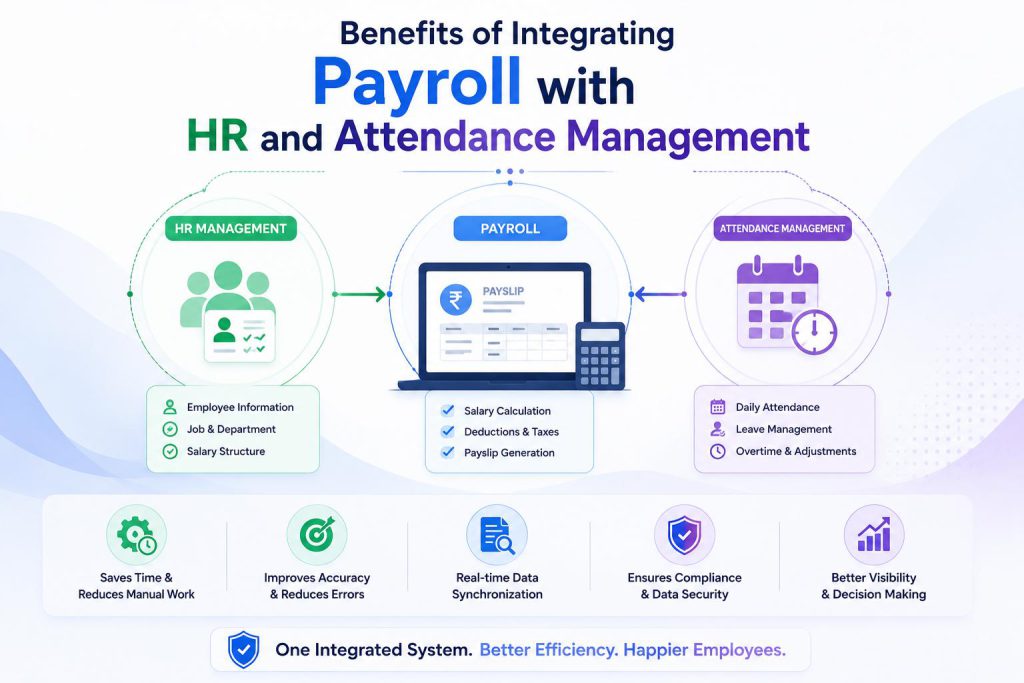
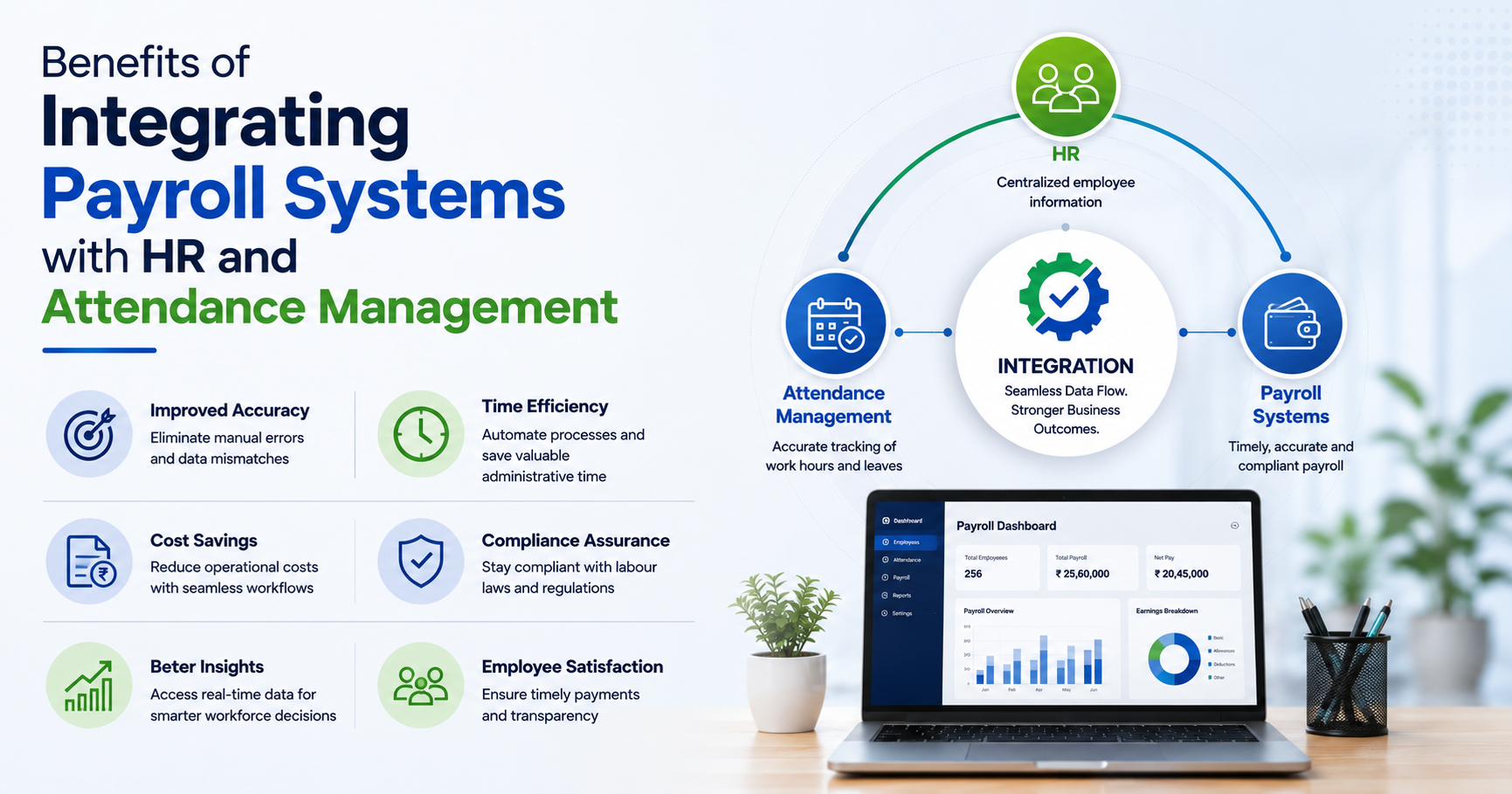
- Accurate Salary Calculation
When attendance, leave records, and overtime details are directly connected to the payroll system, salary calculations become highly accurate and automatic. There is no need for HR teams to manually enter work hours or days present, reducing the chances of mistakes. The system pulls real-time data from attendance and HR modules, preventing errors such as overpayment, underpayment, missing deductions, or incorrect overtime calculations. With precise salary processing, employees receive the correct amount every time, resulting in fewer complaints and increased trust in the organization’s payroll process. - Faster Payroll Processing
In many organizations, manual payroll processing can take several days or even weeks, especially when HR teams need to collect data from multiple sources. With an integrated system, payroll can be processed instantly because all necessary information is already available within the system. HR teams can complete payroll tasks in just a few clicks, saving time, effort, and stress. Faster processing ensures that employees receive their salaries on time every month, improving satisfaction and maintaining a smooth payroll cycle. - Reduced Human Errors
Manual data transfer between attendance records, HR files, and payroll systems increases the risk of mistakes such as typing errors, incorrect numbers, missing entries, or mismatched attendance data. These errors can lead to incorrect salaries and disputes. Integration automates the entire data flow, ensuring that information is accurate and consistent across systems. As a result, payroll accuracy improves significantly, reducing disagreements and minimizing the need for corrections or reprocessing. - Real-Time Attendance Sync
Integrated systems automatically update payroll when attendance is recorded, leaves are approved, overtime is added, or shifts are changed. This real-time synchronization eliminates the need for HR teams to manually update records and reduces confusion during payroll processing. With up-to-date information available instantly, last-minute corrections become unnecessary, making payroll smoother and more reliable. - Better Compliance and Transparency
Payroll processing must comply with various legal and statutory requirements such as PF, ESI, TDS, professional tax, and labor laws. Integrated systems maintain accurate and organized records automatically, reducing the risk of compliance errors and penalties. Employees also benefit from increased transparency, as they can view their attendance, salary structure, deductions, and benefits clearly. This builds trust and ensures that organizations remain compliant with regulatory standards. - Improved Employee Satisfaction
Employees feel frustrated when their salaries are incorrect, overtime is missed, or payments are delayed. Integrated payroll systems ensure that salaries are accurate and processed on time, eliminating these common issues. When employees are confident that they will be paid correctly, morale increases and trust in the organization strengthens. Happy employees are more engaged, loyal, and productive, contributing positively to the workplace environment. - Reduced Administrative Work
Without integration, HR teams spend a large portion of their time collecting attendance data, verifying leave records, cross-checking information, and entering details manually. Integration automates these repetitive tasks, freeing HR professionals to focus on more strategic activities such as employee development, training, engagement initiatives, and recruitment. This shift enhances productivity and allows HR to contribute more meaningfully to organizational growth. - Easy Reporting and Analytics
An integrated payroll system can generate detailed reports automatically, including salary breakdowns, attendance summaries, leave usage trends, overtime records, and department-wise costs. These insights help management analyze workforce patterns, identify problem areas, and control expenses more effectively. With accurate and accessible data, leaders can make informed decisions that support operational efficiency and financial planning. - Streamlined Onboarding and Exit Process
When new employees join, their information flows seamlessly from HR to payroll, allowing salary structures and benefits to be applied immediately. Similarly, when employees leave, the system simplifies final settlement processes by accurately calculating leave encashment, pending deductions, and other payouts. This reduces confusion, speeds up processing, and creates a smoother experience for both HR teams and employees. - Cost Savings
Integration significantly reduces costs associated with manual work, paperwork, administrative hours, and salary errors. Mistakes in payroll can lead to financial loss, compliance penalties, and additional work to correct issues. Automation minimizes these risks and allows businesses to operate more efficiently, saving money while maintaining accuracy and reliability. - Better Decision-Making
With accurate and consolidated data available in one system, management can make smarter workforce and financial decisions. They can plan staffing needs, control salary budgets, analyze overtime usage, and identify areas where efficiency can be improved. Data-driven insights support strategic planning and help organizations manage growth effectively.
Final Thoughts
Payroll is one of the most important functions in any organization. When employees are paid correctly and on time, trust increases and productivity improves. However, manual payroll systems create unnecessary stress, errors, and delays.
Integrating payroll with HR and attendance systems transforms the entire process. It automates calculations, ensures accuracy, reduces workload, and provides real-time visibility. HR teams can finally focus on people, not paperwork. Businesses gain efficiency, compliance, and cost savings.
If your organization still handles payroll manually or with disconnected systems, now is the time to upgrade. Integrated payroll is not just a technology improvement—it is a business necessity.